2027 Edition at a Glance
| Edition | 2027 card |
|---|---|
| Status as of November 2026 | Not yet on sale — the 2026 card is still the edition in force |
| Orders open | January 2027 (date set by the League) |
| Delivered | Spring 2027, ahead of the April switch |
| Takes effect | April 1, 2027 |
| Expires | March 31, 2028 |
| Format | Standard 5⅙" × 4" and Large Print 6⅙" × 4¾" |
| Price | Set by the League at launch — see its store |
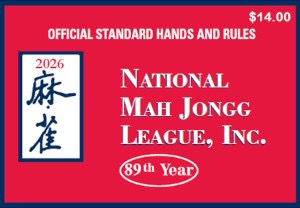
Most mahjong variants can be played from memory. American Mah Jongg cannot. Sit down at any American table without the current card and you are not playing a harder version of the game — you are not playing the game at all.
That single printed sheet is the reason American Mah Jongg looks the way it does: an annual card, published by the National Mah Jongg League, listing every legal winning hand for the year and nothing else. It is not a cheat sheet. It is the rule set.
This page covers the 2027 edition: what it is, when it replaces the 2026 card, why it holds that position, how to read it, and how American Mah Jongg differs from the Chinese and Japanese versions most players already know.
What the NMJL Card Actually Is
The National Mah Jongg League has published the card since 1937. Its formal title is Official Standard Hands and Rules — which describes it precisely: a list of hands, plus the rules needed to read that list.
Each edition contains every legal winning hand for the year, organized into sections; the tile composition of each hand, written in the card's own shorthand; the point value of each hand; whether a hand may be exposed or must stay concealed; and the rules printed on the reverse side.
Nothing on the card is optional. A combination that is not printed there is not a winning hand that year, no matter how elegant it looks on the table.
What Never Changes, Whichever Year It Is
- Legal hands exist in one place only. One card, and one card only, states the hands in force.
- A complete hand is always 14 tiles, built from a 13-tile deal by drawing and discarding.
- Equipment is fixed. A standard American set carries eight Flowers and eight Jokers — 152 tiles in all — and that does not change from year to year.
- Color encodes suit count, never suit name. A hand printed in three colors needs three suits; the card never says which.
- C means concealed, X means exposed. One letter changes how the entire hand is played.
- Jokers replace only inside a Pung, Kong, Quint or Sextet — never a single, a pair, or a tile inside a printed sequence.
- Section families stay fixed, hands do not. Year hand, 2468, 13579, any like numbers, consecutive run, winds and dragons, 369, singles and pairs, quints — the shelves stay, the contents are rewritten each spring.
- The White Dragon is a suit-less zero. The card prints it plainly: "WHITE DRAGON IS USED AS ZERO '0'. IT MAY BE USED WITH ANY SUIT."
The card also carries this printed notice of its own: "This document is protected by copyright laws. It is illegal to reproduce it."
Why It Decides the Game
Without the Card, There Is No Winning Hand
In Chinese mahjong, a winning pattern is a concept you learn once and carry for life. In American Mah Jongg, a winning pattern is a line printed on a specific edition of a specific card. Change the edition and the same fourteen tiles stop being a win. This is why experienced players keep the card open on the table for the entire game. They are not checking a reference — they are reading the rule currently in force.
The Card Resets Every April 1
The League issues a new card each spring. The membership year runs April 1 to March 31, and the hands change with it: new patterns appear, familiar ones disappear, and the year section is rebuilt around the new digits. The consequence is blunt. A hand that won in March can be dead in April. Any player who has not updated is playing last season's game.
Everyone at the Table Must Use the Same Edition
American Mah Jongg is a synchronized game. If one player reads the 2026 card and another reads the 2027 card, the table is running two rule sets at once — different legal hands, different point values, unresolvable disputes. Every club, class, and tournament therefore specifies the edition in advance. Mixed editions are not a minor inconsistency; they make the table unplayable.
How to Read the NMJL Card
Reading the card is a skill, not memorization. Four things carry almost all of it.
Sections
Hands are grouped by pattern family — the year hand, 2468, 13579, any like numbers, consecutive run, winds and dragons, 369, singles and pairs, quints. You do not choose a hand at the deal. You choose a section, then narrow.
Colors
The card is printed in three ink colors. Color encodes suit count only — one, two or three suits — and never names which suit. A hand in three colors needs three suits; you decide which is which. A hand in one color needs one suit.
C and X
A hand marked C is concealed: you may not call discards to expose its groupings. A hand marked X may be exposed. One letter changes how the entire hand is played.
Groups
Repeated numbers show how many copies of a tile belong together — 1 a single, 11 a pair, 111 a pung, 1111 a kong, 11111 a quint, 111111 a sextet. Jokers may substitute inside pungs, kongs, quints and sextets — never in singles, pairs, or tiles inside a printed sequence. Every completed hand totals fourteen tiles.
How It Differs From Other Mahjong
| American Mah Jongg (NMJL) | Chinese mahjong | Japanese riichi | |
|---|---|---|---|
| Where patterns come from | A new card each year; hands fully rewritten | Fixed patterns, with regional variations | A fixed yaku table |
| Legality test | Must match one complete printed line | Local table rules | Yaku conditions |
| Annual reset | Yes, every April 1 | No | No |
| Reference during play | The card stays open on the table | Played from memory | Played from memory |
The difference is structural rather than stylistic. Chinese and Japanese mahjong ask you to learn a system once. American Mah Jongg asks you to learn how to read, then re-read every spring. That is also why the card is the one object no American player can substitute: it is not a reminder of the rules, it is the only place the rules exist in usable form.
Standard vs. Large Print: Which Card to Choose
Both editions list the same hands and carry the same rules. They differ only in size. Standard is 5⅙" × 4", the edition most players carry. Large print is 6⅙" × 4¾", with larger type for easier reading across the table. Prices are set by the League at launch and change between editions.
Players who wear reading glasses, teach beginners, or play in low light generally prefer the large print edition. Groups sometimes order several of one size so the whole table reads at the same distance.
The single rule that matters: whatever size you buy, every player at the table needs the same edition year.
The Annual Card Calendar
| Timing | What happens |
|---|---|
| January – March | The new card goes on sale; pre-orders ship ahead of April |
| April 1 | The new edition takes effect; the previous card expires |
| April 1 – March 31 | The current edition is valid for club and tournament play |
| February onward | Search interest for the new card peaks through the spring |
If you are buying for a group, order before April. Cards ordered after the season starts still ship, but every week without one is a week the table cannot legally play.
Where to Get the Current Card
The card is published and sold by the National Mah Jongg League. The League's store is the primary source, and it also authorizes a limited number of retailers.
Buy the current card directly from the National Mah Jongg League's official store. Prices, sizes, and shipping terms are set by the League and change without notice.
Outside the United States, postage is additional and payment must clear through a US bank or money order. The League also accepts orders by mail.
Counterfeit and outdated cards circulate widely online, especially in spring. A card listing last year's hands is not a bargain; it is an unusable card.
Racks and Pushers: What Actually Works
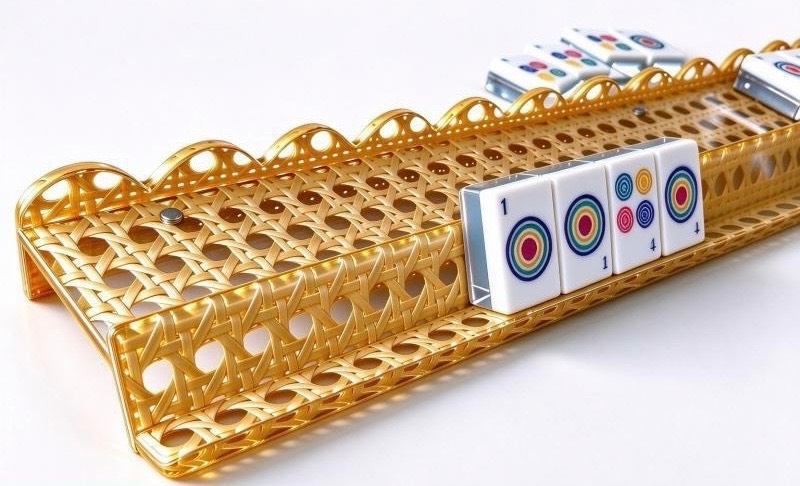
A rack is the least glamorous object on the table, and the first thing you would miss. It holds your hand upright so that only you can read it, keeps fourteen tiles from sliding into a heap, and gives the wall a flat surface to sit on. Four racks and four pushers are what turn a pile of tiles into a game that actually moves.
Three Reasons Every Table Needs Them
Your hand stays private and in order. Tiles laid flat on the table are visible to everyone and impossible to sort. A rack angles them toward you alone, so you can rearrange a hand mid-Charleston without exposing it and without losing track of what you were building.
The wall moves without collapsing. The pusher is the other half of the pair: a straight edge you slide forward to move your wall into the center. Push a wall by hand and the row scatters; push it with a pusher and it arrives intact, every time, in the same shape you built it.
Everyone plays at the same speed. Four racks mean four players working at their own pace instead of waiting for the one person who is still sorting tiles on the tabletop. It sounds minor until you have played a hand without them.
The NMJL card is the shortest route to understanding American Mah Jongg, because it is not a supplement to the game — it is the game's current state, printed and dated.
Learn to read it once and the annual change stops being an inconvenience. It becomes what the League intended: a new set of problems every spring, with the same fourteen tiles.
We are independent and not affiliated with, endorsed by, or sponsored by the National Mah Jongg League, Inc. "National Mah Jongg League," "NMJL," and the annual card are the property of the League. The card is protected by copyright; this page explains how to read it and does not reproduce its contents.
Last updated: November 2026. Edition details verified against the League's official store and the nine card-face section images.